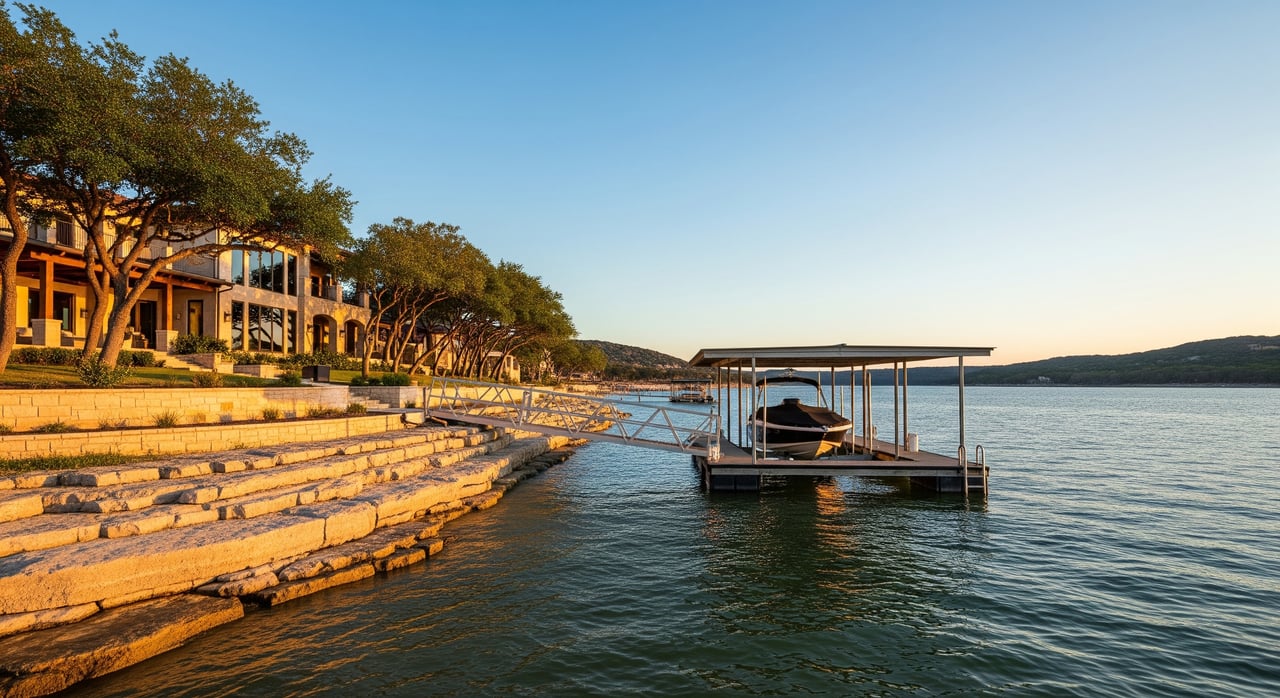

A title company asks for the dock permit. The seller says there isn't one. The buyer's agent assumes that means the dock is unpermitted, and now everyone is nervous about a structure that has been sitting on that shoreline for fifteen years without incident.
Here is what almost nobody in that room knows: for most residential docks on Lake Travis, there was never a permit to produce. The Lower Colorado River Authority does not require a permit, registration, or fee for a residential dock of 1,500 square feet or less. The dock can be entirely legal and entirely unpermitted at the same time, because the two words describe different things on this particular lake.
That gap between what buyers expect to see on paper and what the regulator actually requires is the friction point that catches Lake Travis closings off guard, and it is worth understanding before you are staring at it during an option period with a deadline three days out.
The Paperwork That Doesn't Exist
Most single-family docks on Lake Travis fall under 1,500 square feet of water surface area. For those docks, LCRA's own guidance is direct: no permit, no registration, no fee. That single fact undercuts the blanket advice repeated across most Lake Travis buying guides, which tells buyers to chase down "the dock permit" as if every structure on the water has one.
What the small dock does need is compliance with LCRA's Safety Standards for Residential Docks on the Highland Lakes. Those standards cover:
- Flotation, including a requirement that foam be encased so it cannot break apart and sink the structure
- Lighting sufficient to make the dock visible at night, which matters more when low water has pushed the dock farther from shore than it looks on a summer afternoon
- Anchoring strong enough to hold the dock in place during a flash flood, a real risk on a lake LCRA itself flags as sitting in what Central Texas calls Flash Flood Alley
- Maximum distance from shore, a limit that still applies even when the shoreline has moved
None of that shows up in a stack of paperwork the seller can hand over. It shows up in the physical condition of the dock, which means the closing question isn't "where is the permit" but "does this structure meet the standard," and that is a job for a contractor who works the lake, not a document request to a government office.
The License Nobody Mentions
The permit confusion gets worse once you leave LCRA's baseline and hit the layer underneath it: local water districts that manage their own stretch of shoreline.
Travis County Water Control and Improvement District No. 17 is one of them, and its dock policy says something the generic buying guides skip entirely. The license it issues to a homeowner is personal. It states plainly that it is not transferable, and that any change in ownership requires the new owner to execute a fresh license agreement with the district, not simply inherit the old one. The district does waive the one-time license fee for a subsequent purchaser, but the annual fees start again under the new owner's name.
That is the opposite of how most people assume dock paperwork works. A house and its attached structures typically pass to the new owner at closing without anyone re-filing anything. A WCID 17 dock license does not follow that pattern. It expires, functionally, the moment the deed changes hands, and a new one has to be requested.
If your shoreline sits inside a district like this, the transferability question isn't hypothetical. It is a checklist item with a specific district office to call, and skipping it means closing on a house with a dock license that technically belongs to someone who no longer owns the property.
When the Dock Actually Does Need a Real Permit
The picture flips again once a structure crosses the 1,500-square-foot line. At that size, LCRA reclassifies a floating dock as a marina facility, which pulls it under the Highland Lakes Marina Ordinance instead of the lighter residential safety standards. A marina facility does require a formal LCRA permit, and the rules around it changed meaningfully in 2023, when LCRA's board approved the first significant update to that ordinance in more than two decades. The revision restructured annual fees, set a two-year deadline for marinas to replace older unencapsulated foam flotation, and banned new community marinas outright, the shared docks some neighborhoods used in place of individual residential structures.
For a homeowner with an oversized boathouse, a multi-slip dock, or a legacy structure built before the current rules existed, that reclassification matters. A buyer inheriting a permitted marina facility is inheriting compliance obligations tied to a 2023 rule change, not a document that quietly sits in a drawer.
Here is how the three regimes actually sort out, condensed to what a buyer needs to check before writing an offer:
| Dock type | Regulating authority | What exists on paper |
|---|---|---|
| Residential, 1,500 sq ft or less | LCRA safety standards only | Nothing to transfer, must meet physical safety standards |
| Residential in a water control district (such as WCID 17) | The district itself | A personal license that does not transfer, new owner must reapply |
| Floating dock or marina facility over 1,500 sq ft | Highland Lakes Marina Ordinance | A formal LCRA permit, subject to 2023 ordinance requirements |
A buyer who asks a seller for "the dock permit" without knowing which row their property falls into is asking the wrong question, and a seller who says "there isn't one" might be telling the truth for reasons that have nothing to do with whether the dock is legal.
Why the Timing of Your Showing Matters Here
Lake Travis was sitting at 94.4 percent of conservation capacity as of September 6, 2026, according to the Texas Water Development Board's reservoir tracking. That is a high-water summer by the lake's recent history, and it changes what a walkthrough can actually tell you.
At high pool, a dock floats close to its original design position, hiding whether it has been extended, relocated, or rebuilt in a way that would trip the distance-from-shore limits LCRA enforces regardless of water level. Docks quietly walked farther into the lake during a dry stretch to keep chasing the water tend to get discovered only when the lake refills and the structure suddenly sits well past its permitted footprint, if it had one, or past the standard, if it didn't.
The practical move for a buyer under contract on a Lake Travis waterfront property is to ask when the dock was last inspected against a low-water baseline, not just what it looks like today. A dock that looks perfectly normal in September at 94 percent full can be sitting somewhere it was never supposed to be, and the current lake level is exactly the condition that hides it.
What This Means When You're Under Contract
Before the option period closes on a Lake Travis waterfront purchase, the working list looks less like "get the permit" and more like a jurisdiction check:
First, confirm the dock's square footage against the 1,500-square-foot line, since that number alone determines whether LCRA paperwork should exist at all. Second, find out whether the property sits inside a water control and improvement district, and if so, request that district's specific license terms rather than assuming LCRA's baseline rules are the only ones in play. Third, for any structure that reads as a marina facility rather than a simple residential dock, ask directly whether the current permit reflects the 2023 ordinance requirements around flotation and fees. Fourth, request a maintenance and inspection history that covers at least one low-water period, not only the current high-water condition.
None of this replaces a licensed inspector's judgment on the physical structure. It does mean the conversation with your agent, your title company, and the seller starts from the right question instead of a generic one borrowed from a buying guide that never mentions which lake, let alone which district, it is describing.
A Few Direct Answers
Does every Lake Travis dock need an LCRA permit? No. Residential docks of 1,500 square feet or less need no LCRA permit, registration, or fee, though they must meet LCRA's safety standards for construction and maintenance.
If there's no permit on file, is the dock illegal? Not necessarily. For a small residential dock, the absence of a permit is normal. The relevant question is whether the structure meets the safety standards, not whether paperwork exists.
Does a dock license automatically pass to a new owner? It depends on who issued it. Some water control and improvement districts, including WCID 17, treat their dock licenses as personal to the licensee and require the new owner to apply for a fresh agreement rather than inherit the old one.
Lake Travis rewards buyers who ask sharper questions than the generic guide provides, and it punishes the ones who assume a document exists simply because every other waterfront market seems to require one. If you are weighing a purchase or a sale on the lake and want a straight answer about what applies to a specific shoreline, Dara Allen can walk through the jurisdiction, the structure, and the paperwork trail before you are three days into an option period wondering why nobody mentioned any of this sooner. Request a Private Home Valuation to start that conversation.